
Insights
Building Flexibility into the Sub-Transmission Network: The Growing Role of High-Voltage Line-Mounted Switchgear
August 20, 2026Traditionally, adding switchgear on sub-transmission networks often meant building new substations. Technologies such as the G&W Electric Viper®-HV recloser are changing that model. Designed for sub-transmission networks up to 72.5 kV, it brings protection, automation and reclosing capability directly onto the line, giving utilities new options for fault management, sectionalising and network resilience.
The result is a more flexible approach to sub-transmission design, particularly where network visibility, restoration times and infrastructure costs are under increasing scrutiny.
Rethinking Switchgear at the Network Edge
Sub-transmission switchgear has traditionally been installed in substations, with switching and protection equipment and instrumentation transformers grouped within a dedicated installation. While effective, this approach can limit flexibility on feeders where it may be uneconomic to build a substation at tee offs to isolate faults on the tee.
High-voltage line-mounted reclosers take a different approach. Installed directly on the network, they provide switching, protection and sectionalising capability at strategic locations, helping utilities isolate faults more precisely and reduce the extent of network interruptions.
Rather than replacing conventional switchgear, they provide an additional tool for improving reliability across complex networks.
The Operational Value of Precise Fault Isolation
The precision with which a fault can be isolated often has a direct impact on restoration outcomes.
Strategically located sectionalising points give operators greater control during fault events, helping contain outages to smaller sections of the network while maintaining supply elsewhere where network design permits.
Effective fault isolation can help utilities:
- Reduce the number of customers affected by an outage
- Improve restoration planning and crew deployment
- Maintain supply to healthy sections of the network
- Support reliability and performance targets
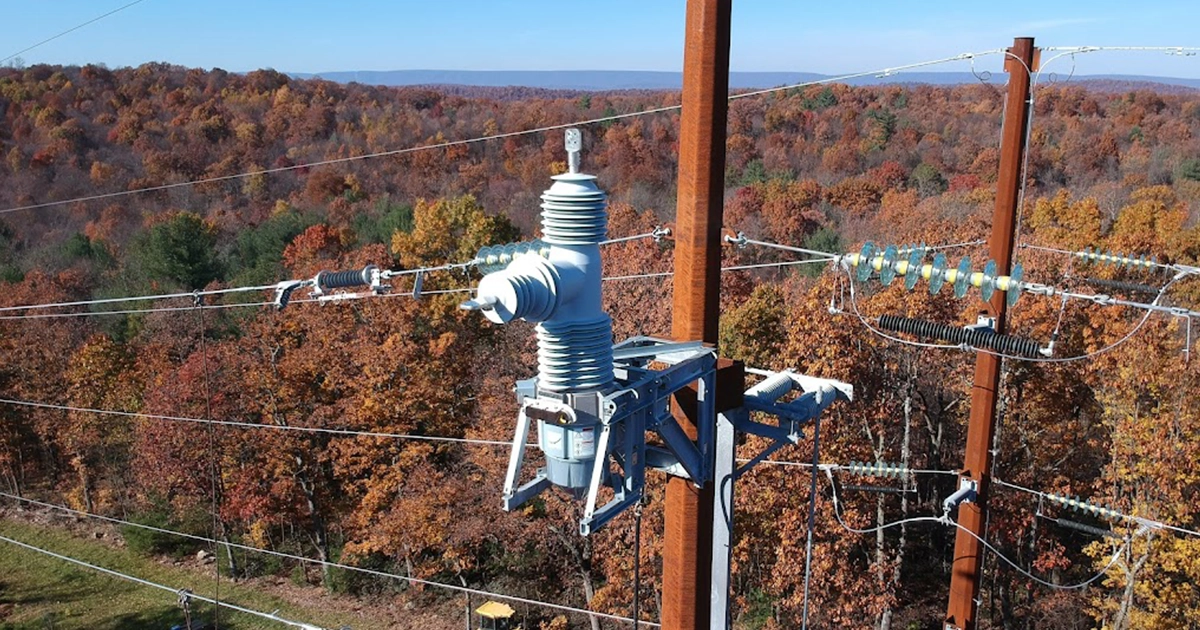
The G&W Electric Viper®-HV recloser combines high-voltage switching, fault interruption and automatic reclosing capability within a compact overhead design. Available in both phase-over-phase and crossarm configurations, it can be deployed across a range of sub-transmission network arrangements while enabling a faster and more controlled response to network events.
Managing Temporary Faults Without Manual Intervention
Many overhead line faults are temporary. Lightning, vegetation contact and environmental factors can momentarily disrupt a line before conditions return to normal.
Reclosing technology is designed to respond to these events automatically. Following a fault interruption, the recloser attempts to restore supply based on a predefined operating sequence. If the fault has cleared, service can be restored without requiring field intervention. If the fault remains, the affected section can be safely isolated.
This capability helps reduce sustained outages while allowing field resources to be directed where they are needed most.
Visibility Is Becoming as Important as Protection
Modern high-voltage recloser platforms provide detailed event recording, monitoring and fault analysis capabilities that help operators understand not only that a fault occurred, but where and why.
Advanced controllers paired with the Viper®-HV platform can incorporate a fault location capability, providing accurate indication of the position of a fault position on a long sub-transmission corridor. For utilities managing hundreds of kilometres of overhead assets, gaining more precise fault location data can reduce investigation time and accelerate restoration activities.
Supporting Network Growth Without Expanding Infrastructure
For Australian distribution network service providers (DNSPs), balancing reliability improvements with project costs, available space and delivery timeframes is an ongoing challenge.
Because line-mounted reclosers can be installed directly onto existing infrastructure, they provide a way to enhance network protection and operational flexibility without the footprint typically associated with additional substation assets or switchyard expansion. The current transformers and voltage sensors are encapsulated in the solid dielectric switchgear poles which are mounted on a crossarm or on a pole while the batteries and protection relays are accommodated in the control cabinet at the foot of the pole, with plug in cables between the control cabinet and the switchgear poles. This results in a standard, compact installation that can be rapidly deployed and that avoids the expense associated with designing, building and maintaining a substation.
This approach can be particularly valuable when accommodating network growth, integrating new connections or improving reliability across existing corridors.
Maintenance requirements are also becoming an increasingly important consideration. Designed as a solid dielectric solution, the Viper®-HV recloser eliminates the need for insulating gases such as SF₆ and is engineered for long service life with minimal maintenance intervention. For utilities operating remote assets, this can help reduce site visits and support more efficient maintenance planning.
Smarter Protection, Greater Flexibility
The evolution of sub-transmission switchgear is not about replacing traditional infrastructure. It is about providing utilities with more options.
Technologies such as the G&W Electric Viper®-HV recloser enable protection, sectionalising, automatic fault restoration and advanced fault location capabilities to be deployed closer to where network events occur. By combining these functions in a compact overhead solution, utilities can improve operational flexibility whilst making better use of existing network infrastructure.
As utilities continue to seek smarter ways to improve reliability and resilience, line-mounted high-voltage switchgear is becoming an increasingly valuable tool in modern sub-transmission network design.